
OUR COMPANY

Audio version of this article
Falling Luggage: An Unpredictable Onboard Hazard
There is always a risk that items stored in overhead bins can shift or become dislodged during taxi, takeoff, landing, or turbulence. Most of the time a dislodged bag causes nothing worse than a startled passenger. On rare occasions, it can cause a serious injury with no doctor on board and no way to know, in the moment, how bad the damage really is.
On a flight bound for Chicago, that risk became real for one passenger struck in the face by a bag that fell from an overhead bin.
Case Study
The Case
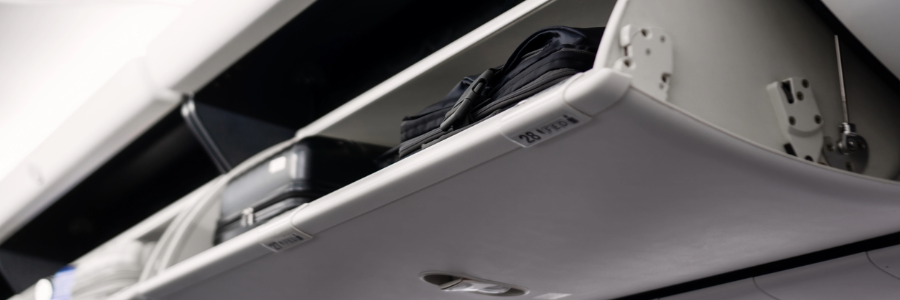
Somewhere over the Midwest, the overhead bin above a row of seats released its contents without warning. A suitcase fell and struck a passenger directly on the forehead, just above her left eyebrow. The impact was sharp enough to open a deep laceration, though she did not immediately register how serious it was.
She pressed a hand to her forehead and felt a sudden, sharp pain. It was only when she saw blood on her hand that the shock gave way to fear. Nearby passengers who witnessed the impact called for help, and the flight crew responded immediately.
One flight attendant contacted MedLink for guidance.
A MedLink physician assessed the injury by phone in real time, walking the crew through what to look for and how to control the bleeding. With the physician's permission, a second flight attendant opened the aircraft's Enhanced Emergency Medical Kit and began treating the wound according to MedLink's direction.
Because the cut was deep and located near the eye, the MedLink team could not rule out a more serious head injury from a phone assessment alone. They made the call to have the passenger examined on the ground rather than wait for her regular physician after the flight ended.
The crew did not have to guess at next steps or manage the handoff alone. MedLink's medical team arranged for emergency medical services to meet the aircraft on arrival in Chicago, so the passenger moved directly from the gate into professional care.
At the hospital, the wound was sutured and a CT scan of her head confirmed no further injury. She was discharged with wound care instructions and a referral to follow up with her primary care physician.
Operational Context
Challenges
No Medical Professional On Board
The crew had to manage a facial wound with visible bleeding using only their onboard training and equipment. Without a physician present, they needed an outside clinical judgment they could trust before touching the wound with anything beyond basic first aid.
Uncertain Severity
A laceration near the eye carries a risk of deeper injury that is not visible from the outside. The crew could not determine on their own whether the passenger needed observation, imaging, or immediate diversion, and guessing wrong in either direction carried real consequences.
Coordinating Ground Care Under Time Pressure
Arranging emergency medical services to meet an aircraft on landing requires coordination that a flight crew cannot manage from the cabin. The handoff needed to happen quickly and cleanly, with no gap between the aircraft doors opening and the passenger receiving hospital-level care.
How We Helped
MedAire's Support
24/7 Physician
Guidance
A MedLink physician assessed the injury by phone within minutes of the crew's call, giving them a clinical read on the wound and clear direction on how to proceed.
Enhanced Kit
Direction
With physician authorization, the crew opened the Enhanced Emergency Medical Kit and treated the wound under direct MedLink guidance, rather than relying on guesswork.
Ground Support
Coordination
MedLink arranged for emergency medical services to meet the aircraft in Chicago, so the passenger moved straight from the gate to hospital care with no delay.