
OUR COMPANY

Audio version of this article
In-Flight Cardiac Events: A Leading Cause of Death Onboard
Chest pain at altitude is rarely straightforward. Symptoms can start on the ground, fade, and return mid-flight, leaving cabin crew to decide in minutes whether they are looking at indigestion or a heart attack. When the event is cardiac, the margin for error is thin: delayed recognition costs heart muscle, and heart muscle lost in the air cannot be recovered on the ground.
83%
Of in-flight deaths are caused by cardiovascular problems like cardiac arrest.
23%
Of aircraft diversions are triggered by cardiac symptoms (MedAire 2025 data)
On a flight from Paris to Miami, a case that first presented as ambiguous chest pain was later confirmed to be a heart attack, and the sequence of events that followed shows exactly what correct, fast coordination looks like.
Case Study
The Case
As the aircraft approached the US coast on a routine flight from Paris to Miami, one of the principal passengers reported severe discomfort in the middle of his chest to a flight attendant. The symptom had started a few hours before the flight and subsided on its own, only to return and reach a state of extreme pain mid-flight.
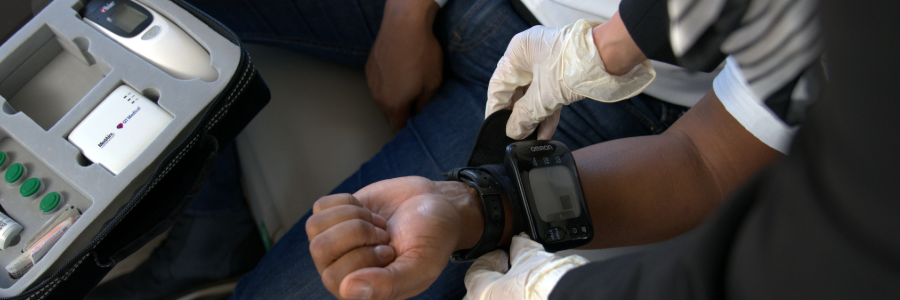
The flight attendant retrieved the Digital Assessment Kit (DAK) and worked through the Chest Pain scenario on the iPad. The passenger's discomfort registered 8 out of 10 on the pain scale, with a dull pressure in the middle of the chest radiating to the jaw and left arm. The electronic blood pressure cuff read 148 over 90. The pulse oximeter showed 89% oxygen saturation, a heart rate of 86 bpm, and a respiratory rate of 16 breaths per minute. The flight attendant transmitted the case summary to MedAire's MedLink and opened a voice connection with a doctor on the ground.
Time was of the essence.
The vitals gave the MedLink doctor a picture highly suggestive of a heart attack. The doctor recommended a tablet of aspirin under routine protocol and requested a 12-lead ECG. The flight attendant followed step-by-step instructions in the app to place the electrodes, using the kit's large torso-sized sticker to apply them correctly on the first try.
The tracing that reached MedLink left no margin for doubt. It showed the classic pattern of a myocardial infarction, and immediate hospitalization was no longer optional. With three hours remaining on the flight to Miami, the crew needed a closer airport.

The flight attendant did not have to guess at a diagnosis, argue with the pilot over airport options, or track down a receiving hospital alone. MedLink discussed the case with the pilot, and Boston came back as the best alternative. MedLink coordinated with air traffic control to have EMS waiting on arrival and forwarded a copy of the ECG so EMS could pass it to potential receiving hospitals ahead of the plane landing.
Two hours after the call began in the air, the passenger was on the table for an angioplasty and stent placement, clearing the blockage in his coronary artery. The treating physician later told MedAire he was impressed by how cleanly the sequence of events had unfolded, a level of coordination he said is not always achieved even for cardiac cases that start on the ground.
Operational Context
Challenges
Symptom Denial Delays Reporting
Passengers commonly downplay chest pain, especially when it comes and goes. "Denial is a major reason for delays in getting medical attention in heart attack cases," says Dr. Paulo Alves, MedAire's medical director. Every hour a heart attack goes unreported is heart muscle that cannot be saved.
No Physician in the Cabin
Flight attendants are not clinicians, yet they are often the first and only responder for a suspected cardiac event. Without a guided assessment tool and a direct line to a doctor, distinguishing a heart attack from less serious chest pain at 35,000 feet comes down to guesswork.
Coordinating a Time-Critical Response
Choosing to divert means weighing airport options, alerting the pilot, and getting EMS and a receiving hospital lined up, all inside a window measured in hours, not days. Any delay in that chain adds directly to the time before the patient reaches a catheterization lab.
How We Helped
MedAire's Support
Real-Time Cardiac
Assessment
MedLink guided the flight attendant through the Digital Assessment Kit's Chest Pain protocol, capturing pain level, blood pressure, oxygen saturation, and a 12-lead ECG in minutes.
Remote Physician
Diagnosis
A MedLink doctor reviewed the transmitted vitals and ECG tracing, confirmed a classic myocardial infarction pattern, and directed aspirin and further medication without hesitation.
Diversion & EMS
Coordination
MedLink worked with the pilot to select Boston as the diversion airport, arranged EMS on arrival, and forwarded the ECG ahead of landing to speed hospital treatment.