Skip to content

MEDAIRE TURNS 40!

Celebrating a legacy of innovation and industry firsts from developing bespoke medical kits to founding the first global response centre for aviation. Our commitment to pioneering solutions continues as we look ahead, ensuring excellence for every journey.

CONTINGENCY360

Your Complete Emergency Response Solution for Business Aviation

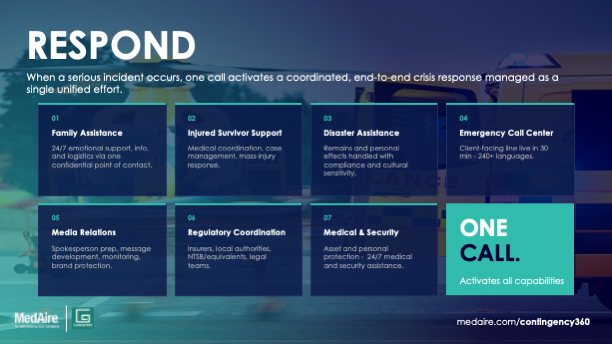
Contingency360 is MedAire's comprehensive Emergency Response Program (ERP) solution designed specifically for business and private aviation operators. It extends beyond standard medical services to provide complete crisis management - from aircraft monitoring to family assistance and media relations - ensuring your flight department can effectively prepare for, respond to, and recover from any incident. Backed by the MedAire-GoCrisis partnership, it delivers expertise previously available only to major airlines, now tailored for private aviation operations.

Why does your Emergency Response Plan (ERP) Need Contingency360?

Every business aviation operation requires a robust Emergency Response Program (ERP), but few have the resources to develop, maintain, and activate comprehensive crisis management systems independently. Contingency360 transforms your ERP from a regulatory requirement into a true operational asset. By integrating advanced aircraft monitoring, family assistance protocols, media relations capabilities, and regulatory compliance guidance into your existing ERP framework, Contingency360 addresses critical gaps that standard emergency response plans often overlook. Our solution provides not just ERP documentation, but complete ERP activation support when you need it most, turning your written procedures into coordinated action during high-stakes situations that extend beyond typical medical or security events.
 
In your operation, readiness matters, but experience saves lives and assets. With decades of global expertise, MedAire doesn't just help you prepare for emergencies; we've been on the ground, in the air, and everywhere in between, responding to real medical and security events in every corner of the world. Our legacy is built on guiding crews, passengers, and organizations through crises with precision, speed, and confidence.
 
More than preparation. Proven response.

Power in Partnership

Contingency360 is made possible through MedAire's strategic partnership with GoCrisis, the world's leading provider of crisis management services across multiple industries. This powerful collaboration combines MedAire's unmatched expertise in aviation health and safety with GoCrisis's specialized capabilities in crisis response, family assistance, and reputation management. Together, we deliver the most capable crisis management solution, with first-hand international crisis and emergency management experience supporting organizations, their people, and their reputations when it matters most.

Process from inadequate preparedness to enhanced readiness, with central Contingency360 hub and outbound capabilities. Comprehensive Emergency Response Solution Inadequate Emergency Preparedness MedAire Contingency360 Enhanced Emergency Readiness Lacking readiness for crises Prepared for any scenario Real-time updates, situational awareness Customized plans, drills, simulations Trained experts, crisis communications Emotional support, logistics

What Makes Contingency360 Different from Standard MedAire Services?

While MedAire's standard services focus on in-flight and destination medical and security emergencies, Contingency360 dramatically expands your coverage to include comprehensive crisis management. This enhanced solution provides critical support that most flight operations, especially smaller one, would otherwise lack access to.
 
Contingency360 builds upon MedAire's decades of emergency response expertise to deliver a complete crisis management system that prepares your operation for incidents beyond medical and security events, including aircraft accidents, reputational challenges, and business continuity threats.
 
From reactive assistance to proactive preparedness and comprehensive response.

What's Included in a Contingency360 Membership?

33%

What Foundational Services Are Provided?

  • One-time protocol customized to small/medium or large operations (domestic and international)
  • Initial gap analysis of ERP with virtual onboard review
  • Providing ongoing support to ensure all stakeholders are prepared to respond effectively in a crisis
  • Annual ERP drill assistance and support (virtual or on-site)
  • Access to MedAire's Contingency360 data via PowerBI for benchmarking and SMS improvement
33%

What Training & Development Resources Are Offered?

  • Access for up to 10 managers to MedAire's ERP e-learning college
  • Access to ERP Assist BOT
  • Annual virtual global "ERP TUNE-UP Symposium" (10 attendees)
  • Access to MedAire's ERP website and Irregular Operations Newsletter
33%

How Does Aircraft Monitoring Work?

Continuous monitoring of aircraft movements provides proactive alerts to enhance situational awareness and response capabilities. Our system monitors for common deviations, including: weather-related issues, maintenance and technical problems, Onboard medical emergencies, security issues, airport/ground closures/ATC complications, fuel/range concerns, or ramp issues.

Immediate Alert System Triggers:

  • Rapid altitude deviations of more than 5,000 ft
  • More than 10 miles lateral off-track
  • Route deviations of more than 200 miles from original course

Response Protocol:
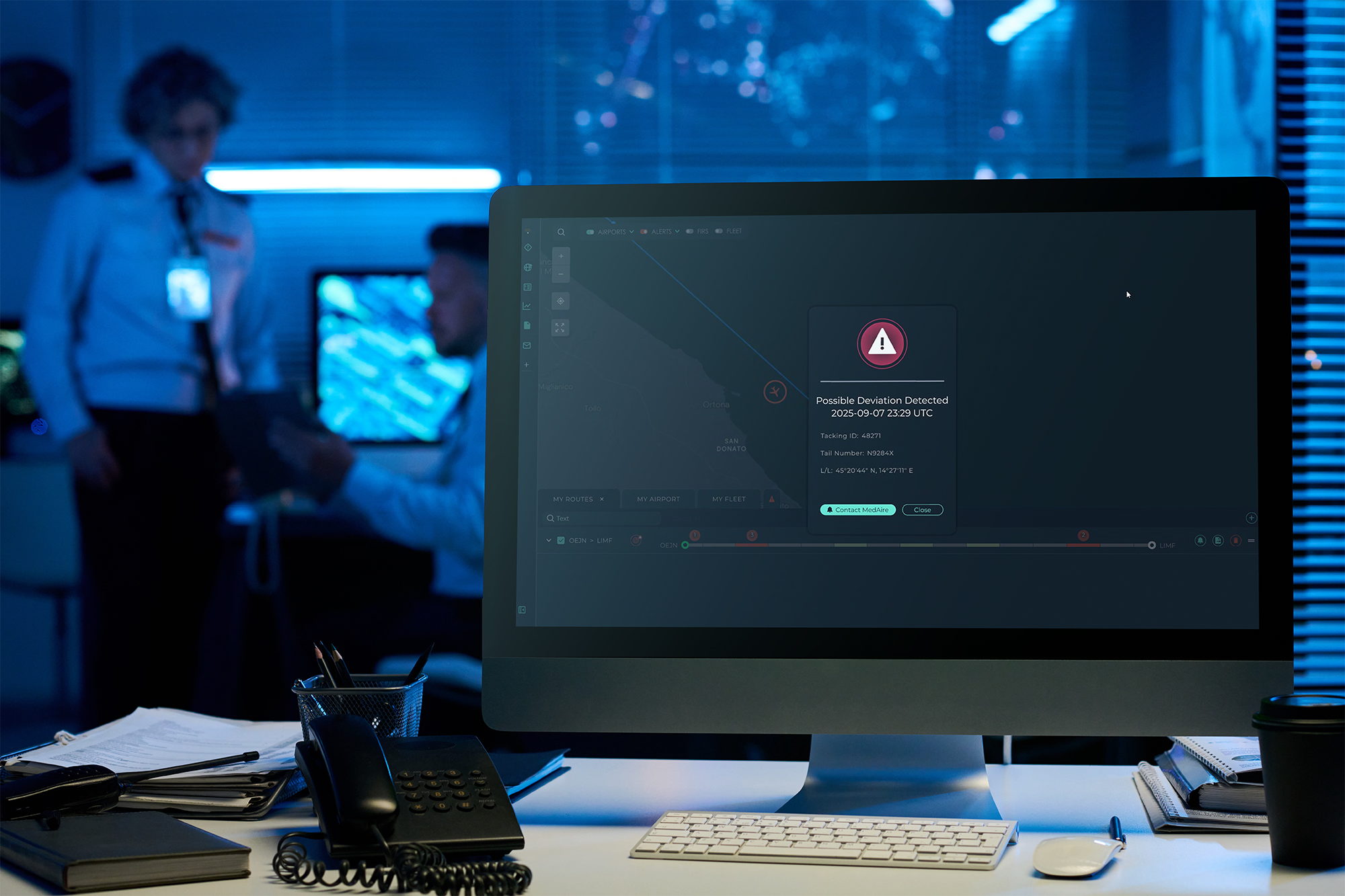
When an alert is triggered, MedAire sends immediate notification to your predetermined contacts with a possible deviation summary (PDS), reference number, and direct contact link to our specialized 24/7 ERP Assistance line through the Business Aviation Desk.

33%

What Crisis Response Capabilities Are Available?

  • Disaster Assistance, including Human Remains and Personal Effects management
  • Mass crew communications system - Crew Check - allows operators to communicate with crew during travel for emergency response alerts
  • Injured survivor support services
33%

What Support Do We Provide to Affected Families?

In the event of an incident, MedAire provides compassionate support to families of those involved, including:

  • Emotional support through trained care teams
  • Coordination of travel and accommodation logistics
  • Ensuring families receive timely and accurate information
  • Cultural and linguistic appropriate support
  • Establishment and management of Family Assistance Centers when needed
33%

How Do We Help Protect Your Reputation During a Crisis?

When incidents occur, protecting your organization's reputation is critical. Our Emergency Response Media Relations team provides:

  • Trained media experts in corporate communications
  • Support for internal and external communications
  • Spokesperson preparation and guidance
  • Client Facing Call Center with 24/7 stand-up capability
  • Media monitoring and response strategy
  • Key message development
  • Family, staff, and media briefings

NEW FROM MEDAIRE

Proactive Crisis Response for Business Aviation

Crisis Response 1 min

This brief overview demonstrates key Contingency360 features highlighted on this page, including real-time aircraft monitoring, alert protocols, and emergency response coordination. See the interface that flight departments rely on for comprehensive crisis management.

Are there any Crisis Response Services not included with Contingency360?

In addition to the standard Contingency360 services outlined above, MedAire offers complementary components to support your operations further and enhance your ability to respond. 

Aircraft/Flight Following Integration with Flight Planning and Scheduling Providers

Seamlessly integrate Contingency360's aircraft monitoring with your flight planning systems and avionics platforms. This creates a unified monitoring environment with automated alerts, eliminating information silos and enabling faster emergency response while streamlining operations and reducing manual monitoring requirements.

 
ERP Plans Documentation (Templates, Reviews, Audits)

Professionally designed ERP templates, regular plan reviews, and formal audits. Our aviation-specific documentation includes role-specific checklists, quick-reference guides, and communication templates tailored to specific roles, transforming your ERP into a dynamic and accessible resource.

 
Developing and Implementing Customized ERP Plans

Our expert team develops comprehensive ERPs tailored to your operation's unique profile. We analyze your flight patterns, organizational structure, and operational environment to create customized protocols addressing your specific risks. Working collaboratively to ensure the plan fully aligns with your operation.

 
Conducting Regular Drills and Simulations

Our aviation crisis experts facilitate realistic practice exercises from tabletop scenarios to full-scale simulations tailored to your operations. We evaluate performance and provide feedback to strengthen emergency readiness, transforming written plans into confident, coordinated responses.

 
Regulatory Guidance for NTSB, EASA, GCAA, FAA, AAIB, ICAO-Annex 13

Our experts provide regulatory guidance across multiple aviation authorities, including notification procedures, reporting timelines, and investigation protocols. We help prepare documentation, understand obligations, and manage authority interactions while protecting your interests and reducing liability.

 
Industry Guidance Updates Including IS-BAO Compliance

We monitor evolving standards from IS-BAO, NBAA, and IBAC, translating requirements into practical guidelines. Regular updates ensure your ERP meets current standards and anticipates emerging requirements, supporting certification and operational excellence.

 
FEATURE SPOTLIGHT

Flight Following for your Aircraft

MedAire's advanced flight following system provides continuous aircraft monitoring with intelligent deviation detection and instant alert capabilities. Experience real-time tracking, automated notifications, and immediate access to expert assistance when deviations occur.
Website Deviation Alert - Command Center View
Click to Enlarge the Image

Frequently Asked Questions

How long does it take to implement Contingency360 for our operation?

Implementation typically begins with a customized protocol development phase and initial gap analysis of your existing ERP. The virtual onboard review process and system setup can usually be completed within a few weeks; however, the timeline depends on the complexity of your operation and any additional services selected.

Do we need dedicated staff to manage Contingency360?

Contingency360 is designed to work with your existing team structure. The service includes access for up to 10 managers to our ERP e-learning college and provides 24/7 support, eliminating the need to hire additional staff. However, you'll want to designate key personnel for training and emergency response roles.

What technology infrastructure do we need to support aircraft monitoring?

MedAire's Portal can support manual input of your flight details and aircraft. By unmasking and/or sharing your aircraft location data with MedAire's secure website, aircraft monitoring is unlocked. For additional fees, you can also set up direct data links with leading avionics and flight planning software providers to remove manual efforts and automate this element of your ERP.

How is Contingency360 pricing structured for different operation sizes?

Pricing varies based on operation size (small, medium, or large) and whether you operate domestically or internationally. The membership includes core services with optional add-on services available. Contact our Business Aviation specialists for a customized quote based on your specific operational profile.

Will this affect our insurance coverage or premiums?

Having a comprehensive crisis management program like Contingency360 may positively impact your insurance profile. We recommend discussing your emergency response capabilities with your aviation insurance provider, as underwriters increasingly value robust crisis management programs.

What's the typical return on investment for Contingency360?

While we hope you never need to activate crisis services, the ROI becomes immediately apparent if an incident occurs. The cost of managing a crisis without proper support often exceeds annual membership fees many times over. Additionally, the proactive monitoring and preparedness elements help prevent minor issues from becoming major incidents.

What constitutes an "activation" of Contingency360 services?

Activation occurs when you contact our 24-hour response numbers for crisis support beyond routine medical or security advice. This could include aircraft incidents, operational disruptions that require family notifications, reputational threats, or any situation that requires crisis coordination. Your initial onboarding and ERP development phase will set these thresholds.

Are there any geographic limitations to your response capabilities?

Through our partnership with GoCrisis and the International SOS network, we provide global coverage. However, response capabilities may be limited in certain regions due to political instability or access restrictions. Our team will provide specific guidance for operations in challenging locations.

How do you coordinate with our existing relationships (legal counsel, insurance, PR firms)?

We're designed to complement, not replace, your existing professional relationships. Our team coordinates seamlessly with your legal counsel, insurance representatives, and other advisors to ensure unified response efforts while leveraging our specialized crisis management expertise.

What happens if we have multiple aircraft and one diverts while others continue as planned?

Our aircraft monitoring system tracks each aircraft individually. If one aircraft experiences an issue, we'll focus crisis response on that situation while maintaining normal monitoring of your other aircraft. Your operations can continue with enhanced awareness of the developing situation.

Can we test or practice using the services without a real emergency?

Absolutely. The add-on services include conducting regular drills and simulations specifically for this purpose. We also provide tabletop exercises and can coordinate practice activations to ensure your team is prepared and familiar with the response process.

How does this work with Part 135 operators versus Part 91 operations?

Contingency360 is designed for business aviation broadly and works with both Part 91 and Part 135 operations. The services scale appropriately for your operational complexity and regulatory environment, with specific guidance available for different operational types.

Does this replace our IS-BAO emergency response requirements?

No, Contingency360 enhances and supports your IS-BAO compliance rather than replacing any requirements. IS-BAO is an international standard that provides a comprehensive framework for managing the safety, security, efficiency, and effectiveness of business aircraft operations. The standard is scalable and flexible, allowing operators of any size to implement requirements that pertain to their specific operations. MedAire has developed a suite of solutions that enable operators to achieve the highest level of compliance and safety standards, aligning with industry standards and civil aviation regulations. Our add-on services include IS-BAO guidance updates to ensure your emergency response program meets or exceeds these standards while providing practical activation support.

How does Contingency360 work with our Safety Management System (SMS)?

Contingency360 fulfills specific SMS requirements and supports certain SMS functions, rather than integrating directly with your SMS. The service meets your ERP documentation and coordination requirements, provides the required ERP training and exercises, and generates operational data that can support your hazard identification and safety performance monitoring processes. However, you'll need to incorporate Contingency360's outputs into your existing SMS framework, documentation, and processes to realize the full safety management benefits.

Can our flight department pilots and crew access training materials independently?

Yes, your membership includes access for up to 10 managers to MedAire's ERP e-learning college, access to the ERP Assist BOT, and the annual virtual ERP symposium. Flight crews also retain access to MedAire's traditional medical and security support services.

What resources are available to run an ERP training exercise?

Effective exercises need three key parts: realistic scenarios, internal and external participation, and documented lessons learned. Contingency360 has created scenarios and facilitation support for both tabletop and functional exercises, and it integrates with your flight scheduling and crew communication systems to provide realistic aircraft-monitoring drills. The ERP e-Learning College offers role-specific training for up to 10 managers, and the ERP Assist chatbot delivers on-demand guidance during planning. Benchmarking data in Power BI allows comparison with anonymized industry peers. For full-scale exercises requiring GoCrisis personnel who have managed real aviation accidents and can simulate the pressure and complexity of multi-agency coordination, family notification, and media response, these are available as an add-on service at additional cost.


How often should you rehearse your emergency response plan?

IS-BAO Section 4.3.3 requires annual ERP exercises at a minimum, with full simulation exercises recommended every 36 months. These standards set the minimum requirements, not the maximum. Annual discussion-based tabletop exercises test notification processes, familiarity with plans, and decision-making, but they do not simulate the pressure of real-time coordination with external agencies, families, and media. International operators, those carrying high-profile passengers, or managing multiple aircraft, should consider semi-annual exercises that cover scenarios such as medical diversions, security incidents, overdue aircraft, and worst-case accidents. Membership in Contingency360 includes access to the annual ERP Tune-Up Symposium, drill facilitation, and the ERP e-Learning College. The aim is to ensure personnel can perform effectively under stress, not just demonstrate familiarity with a document.

What ERP weaknesses typically become visible after aviation crises?

Post-incident reviews consistently reveal the same failure points. The issues are usually not about whether a plan exists but whether roles, responsibilities, and actions are well-understood and tested before an incident. Operators may realize the plan does not clearly define who activates the ERP, who leads the crisis response, who communicates with the client or principal, who handles next-of-kin and press communications, and who coordinates with authorities, handlers, insurers, and aircraft management partners. There is often an over-reliance on a small group of people, and in many business aviation operations, key knowledge resides with just a few senior individuals. If these individuals are unavailable, the response can slow significantly. Family assistance protocols may be documented but are not sufficiently resourced or properly developed. In business aviation, the passenger profile may include high-net-worth individuals, corporate leaders, or public figures who expect privacy, speed, discretion, and tailored support. Many ERPs do not adequately address this. Family notification protocols that exist on paper may never have been tested with actual calls and scripted language. Plans often assume limited public attention or a grace period for handling the media. Incidents involving prominent passengers or sensitive locations, combined with the speed of social media and publicly available flight-tracking tools, can generate immediate and intense media and public interest, requiring proactive communication to protect brand and reputation. Plans that are not regularly reviewed often contain outdated contact lists, personnel who have changed roles, and no backup designations. There are often incorrect assumptions about insurance coverage, availability of legal counsel, and regulatory notification timelines under pressure. There are frequently no pre-established relationships with external crisis response resources, forcing operators to negotiate contracts and vet providers during an incident. Conducting a gap analysis before an incident occurs helps identify these issues while they can still be addressed.

What are the key items to include in an ERP?

At a minimum, an ERP must address the elements outlined in IS-BAO Section 4.1.4 and NBAA Management Guide Section 1.1.6: authority notification procedures, activation of the emergency operations center, internal notification chains, family communication protocols, on-site crew procedures, flight data preservation, media relations, regulatory cooperation, trauma support, and business continuity. Beyond compliance, effective plans include proactive flight tracking that detects overdue aircraft before local authorities are notified; pre-written family notification scripts reviewed by trauma experts; designated spokespeople with media training; established relationships with medical, security, and crisis communication resources in primary operating regions; and scenarios covering events not explicitly addressed by regulations, such as cyber incidents, security breaches, natural disasters affecting base operations, and incidents involving non-employee passengers. Clearly documented roles and responsibilities are essential. The ERP should specify who leads the response, who makes key decisions, and who is responsible for functions such as operations, communications, family assistance, regulator liaison, crew support, passenger care, insurance, legal matters, and record-keeping. For business jet operators, the most critical test is whether the ERP remains operational and usable at 2am with a small team.

What criteria should be for a reunification center to shield families from media contact?

Location selection should prioritize privacy, controlled access, and family protection as the primary criteria. The site should be physically separated from the incident location, company headquarters, and any area where media will congregate, with secure and discreet access to reduce the risk of families being photographed or approached. Security personnel must control all entry points through identity verification and use a sign-in process. Interior layout should include private rooms for individual family briefings, a larger space for group updates, separate areas for children, and dedicated spaces for welfare, mental health, and support services. The venue should also have a strong communications infrastructure, including reliable phones, Wi-Fi, and video conferencing for remote family members. Proximity to airports and hotels matters for families traveling from multiple locations, but this should not come at the expense of privacy or security. Cultural and linguistic support must be arranged in advance based on passenger demographics. GoCrisis maintains trained personnel and established protocols for the Family Assistance Center setup, staffing, and operation across multiple jurisdictions.

Should operators use a third-party for post-incident handling, or build that capability?

The economics and expertise requirements make a fully internal capability impractical for most operators. Mass-casualty response, family assistance, and crisis communications are specialized fields that require ongoing training, 24/7 availability, multilingual skills, and global reach. An operator experiencing a major incident perhaps once a decade is unlikely to sustain that level of readiness internally. IS-BAO Section 4.1.4(g) and NBAA guidance both acknowledge the role of external entities in family assistance and recommend that ERPs include details on how to engage these resources. The key question is whether to establish that relationship before or during an incident. Reputable emergency response providers will not be needed because a strong response relies on a pre-established partnership and relationships, vetted response resources, in-place contracts, and integrated protocols within your ERP. This results in a single uncomplicated activation call, followed by a comprehensive response from expert emergency responders with real-world experience. This is not about outsourcing responsibility for the response; it’s about providing the specialized resources necessary to meet the needs, aligned with industry standards and the expectations of families and the public. Operators will still need internal resources to activate the ERP, lead decision-making, handle client and stakeholder communications, coordinate with authorities, and manage the response. Contingency360 offers access to 28 assistance centers, over 91,000 vetted providers, thousands of specialized crisis responders strategically located worldwide, with real-world deployment crisis experience across commercial and business aviation, with activation protocols already integrated into your emergency response system.