
OUR COMPANY

Audio version of this article
Altered Mental Status: A Complex In-Flight Presentation
Altered mental status can be one of the most difficult presentations a cabin crew can face in-flight. The causes range from dehydration and hypoxia to a neurological event requiring urgent intervention. When the cause is unclear, it can be difficult to determine whether the passenger can safely continue to their destination or whether a diversion should be considered.
When a passenger's confusion has to be relayed from the cabin to the flight deck and on to a MedLink physician, detail can be easily lost along the way. This case shows what changes when that gap is closed before the call is made.
9%
of flight diversions are linked to altered mental status in-flight
40+
years of in-flight medical data built into the in-flight app assessment scenarios
350,000 min
crewmembers using the in-flight app
01
The Case

What Happened
A flight was operating a transatlantic route when a passenger in his early fifties began presenting with confusion and disorientation. When the flight attendant checked on him, he was struggling to recall where he was going and unable to maintain a clear line of thought.
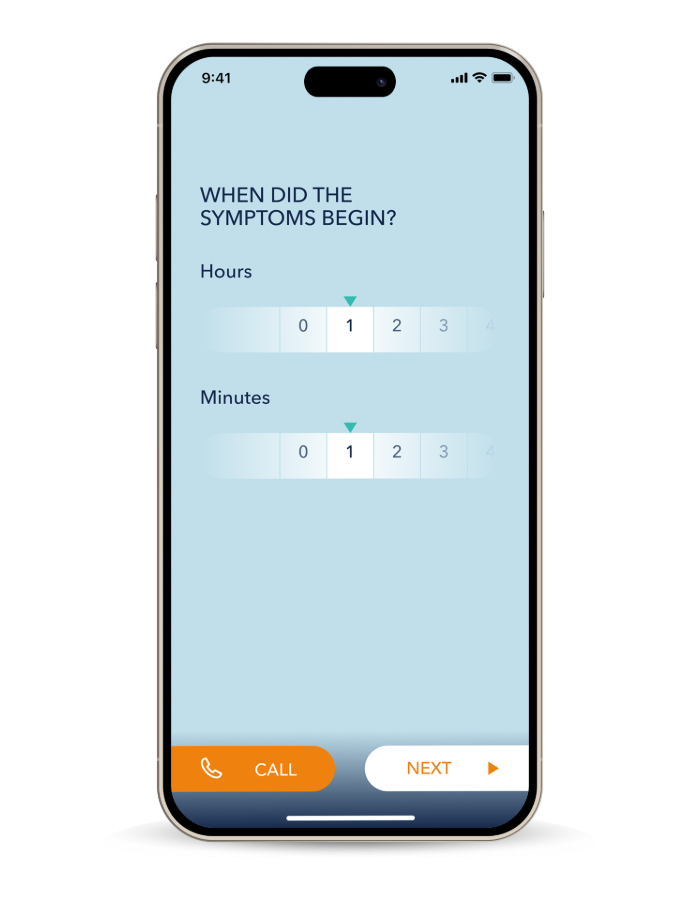
The cabin attendant opened the In-Flight App on the onboard iPad and selected the Altered Mental Status scenario from the in-flight assessment tool. The app guided her through a structured sequence: immediate actions to take at the seat, then prompts to record the passenger's symptoms, observed behavior, vital signs, medical history, current medications, allergies, age, and the timeline of onset.
By the time the assessment was complete, she had a full, structured clinical summary of the passenger's condition, captured during the assessment rather than reconstructed from memory afterward. She tapped "Call" in the Situation Summary screen. Over the aircraft's onboard Wi-Fi, a VoIP call connected her directly to a MedLink physician. The physician had access to the complete clinical picture before the conversation began.
There was no need to relay symptoms from scratch. No risk of a detail being forgotten under pressure. No time spent asking the crew to repeat or clarify what had already been observed.
CLINICAL RELEVANCE
Altered mental status causes around 9% of in-flight diversions. Without a structured assessment, the crew is limited to describing symptoms verbally, which may make it harder to assess whether a diversion is necessary.
02
The Challenges
A Presentation That Demands Clinical Precision
Altered mental status has a wide range of causes, some benign and some time-critical. Crew cannot be expected to differentiate between them under pressure. The quality of the guidance MedLink provides depends directly on the quality of information MedLink receives.
The Limits of Verbal Relay
A traditional in-flight consultation means a crew member describing symptoms from memory. Information is filtered and sequenced by what they think is relevant, then passed to MedLink via the captain. Details that matter clinically can be easy to mis-hear or omit entirely.
Time
When a diversion decision is on the table, every minute of uncertainty has an operational cost. A consultation that opens with a structured summary moves faster than one that begins from scratch.
Without a Structured Assessment
Leadership in the cabin and on the ground would be working from different pictures of the same situation. That gap, between what the crew observed and what MedLink receives, is where diagnostic uncertainty and avoidable diversions begin.
03
MedAire's Support
The In-Flight Assessment Tool
The app guided the cabin attendant through the exact clinical information MedLink needed. The scenario-based structure was built on more than 40 years of in-flight medical data, covering the most common presentations and the most life-threatening events.
The physician reviewed the possible explanations with the crew and identified dehydration as the most likely cause, combined with mild hypoxia. Management instructions were sent directly to the app so the crew had a written record to work from.
The passenger was repositioned, given fluids, placed on low-flow oxygen, and monitored closely. His condition improved progressively over the following 40 minutes.
Structured Assessment
Scenario-based tool built on 40+ years of in-flight medical data. Guides crew through every clinically relevant data point before the call is made.
Physician-Ready Data
MedLink receives a complete clinical summary before the conversation begins. The consultation starts with analysis, not data collection.
Written Guidance in the App
Management instructions sent directly to the app, giving the crew a clear written record to follow and reference throughout monitoring.
04
The Outcome

Successful Operation
The passenger recovered during the flight and arrived at destination without requiring further intervention. The crew handled the event calmly and methodically, and the pilot had a clear clinical recommendation in time to support the operational decision. The flight arrived on schedule.
The outcome mirrors many MedLink cases managed well: a situation handled correctly, a flight completed on schedule, a passenger who arrived safely.
What Was Different
What distinguished this case was not the outcome but how quickly and clearly the crew and physician reached the same understanding of what was happening. In a medical event, the quality of the conversation between the cabin and the ground determines the quality of the care.
The Lesson
The in-flight assessment tool is designed to ensure that information is complete, structured, and in the physician's hands before the first word is spoken. Not as a replacement for clinical judgment, but as the foundation for it.
That is what MedAire's in-flight App delivers.
Find out how the in-flight app supports your operation
Explore the In-Flight App