
OUR COMPANY
Dec
11,
2025
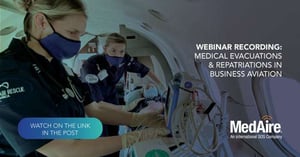
Medical Evacuations & Repatriations in Business Aviation
Complete the form to watch
Enter your details to access the recording.
HOW DOES THE MEDICAL EVACUATION PROCESS WORK IN BUSINESS AVIATION?
Understanding the 24-72 hour preparation window, accurate information requirements, and bed-to-bed coordination can mean the difference between rushed decisions and optimal patient outcomes.
MedAire's expert team provides complete transparency into the proven evacuation process, explaining the critical distinctions between EMS, evacuations, and repatriations, and why thorough planning with vetted providers protects patient safety and delivers successful outcomes.
WHAT DOES THE WEBINAR COVER?
-
Key Distinctions: EMS, Evacuation & Repatriation EMS provides immediate on-scene emergency transport to hospitals. Evacuations transfer patients from lower to higher levels of care when local capabilities are inadequate. Repatriations return stabilized patients home for ongoing care.
-
Why the 24-72 Hour Timeline Protects Patient Safety Thorough preparation ensures the right medical team, appropriate equipment, proper aircraft, landing permits, receiving hospital coordination, and compliance with HIPAA/GDPR privacy regulations—rushing this process risks inadequate care during transport.
-
The Importance of Vetted Providers & Upfront Payment MedAire's global vetting process reviews maintenance records, medical certifications, and equipment standards. Upfront payment secures dedicated resources (aircraft, medical teams, permits, ground transport) preventing last-minute gaps in care.
Understanding EMS, Evacuation & Repatriation
-
EMS (Emergency Medical Services): Ambulance services providing immediate emergency care and on-scene response—transports patients from incident location (hotel, aircraft, home) to hospital or from hospital to air ambulance
-
Evacuation: Transfer of a patient from a lower level of care to a higher level of care when local medical capabilities are inadequate for the condition (fractures, heart attack, stroke requiring specialist care unavailable locally)
-
Repatriation: Movement of a stabilized patient from current location back to their home country for ongoing care and rehabilitation—driven by patient preference for familiar surroundings and support networks
-
Decision factors: Patient stability (must be stabilized before transport), local medical quality and capabilities, specialist availability, hospital cleanliness and JCAHO certification standards
The Medical Evacuation Process: Step-by-Step
-
Information gathering (medical & logistical): Patient location and current status, destination details (home, hospital, facility), distance calculations (hospital to airport, airport to final destination), medical condition assessment, required equipment and medications
-
Provider identification & quote presentation: Identify vetted air ambulance providers capable of mission, present options and costs to client, obtain approval and secure financial commitment upfront
-
Mission activation: Activate provider resources (aircraft, medical team, ground ambulances), apply for landing permits at origin and destination airports, coordinate receiving hospital bed availability and physician acceptance
-
Medical team selection: Match appropriate medical professionals to patient condition (paramedic, nurse, doctor, respiratory therapist, ICU team with ventilator and cardiac medications)
-
Equipment preparation: Source specialized equipment based on patient needs (neonatal pulse oximeters, continuous-flow oxygen concentrators, appropriate-size nasal cannulas, monitoring devices)
-
Continuous monitoring: Track mission from pickup through safe arrival at destination, conduct medical handover to receiving team, provide bed-to-bed service with all medical records and medications transferred securely
Why Accurate Information Upfront Expedites the Process
-
HIPAA & GDPR compliance: Information gathering respects privacy regulations—data held securely and only shared with essential providers (air ambulance, hospitals) with patient or power-of-attorney consent
-
Right medical team assignment: Detailed clinical information determines whether patient needs paramedic, nurse, doctor, respiratory therapist, or full ICU team
-
Proper equipment sourcing: Medical details ensure correct medications, oxygen delivery systems, monitoring equipment, and specialized devices are on board
-
Receiving hospital coordination: Advance notification confirms bed availability, accepting physician, appropriate department/ward, and family contact with facility
-
Avoid back-and-forth delays: Complete information from the start allows MedAire to begin coordinating immediately instead of waiting for missing details
The 24-72 Hour Preparation Window: Why It's Essential
-
Adequate medical team allocation: Identify and schedule appropriately certified professionals (neonatal/PALS certified nurses, ICU-experienced teams, specialty-trained escorts)
-
Proper equipment sourcing: Obtain specialized medical devices that may not be off-the-shelf items (pediatric equipment, neonatal monitors, continuous-flow oxygen with proper regulators)
-
Aircraft identification & readiness: Match aircraft type to mission distance, passenger needs, and companion requirements; ensure maintenance and safety standards are met
-
Landing permits & airport coordination: Apply for permissions to land at origin and destination airports, arrange ground ambulance services at both ends
-
Receiving facility confirmation: Coordinate with destination hospital to confirm bed availability, accepting physician, and appropriate level of care
-
Risks of rushing: Inadequate preparation can result in wrong equipment on board, unqualified medical personnel, inability to handle in-flight incidents, or no receiving care arranged at destination
Why Vetted Providers & Upfront Payment Matter
-
MedAire's vetting process: Teams review air ambulance maintenance records, medical certifications, equipment maintenance logs, and regulatory compliance—providers not meeting standards are decertified from network
-
Hazards of unvetted providers: May cut corners on aircraft maintenance, allow medical certifications to lapse, fail to maintain medical equipment properly, or provide incomplete services (aircraft only, no ground transport or medical team)
-
Bed-to-bed service: MedAire coordinates pickup at house/hospital, ground transport to airport, air ambulance flight, ground transport at destination, safe delivery to receiving facility with full medical handover
-
Why upfront payment is required: Providers allocate dedicated resources (aircraft, medical teams, apply for permits, arrange ground ambulances)—securing payment ensures these resources remain committed to the mission
-
Real-world example: Client attempted cheaper Paris-to-US repatriation independently; provider offered aircraft only (no medical team, ground transport, or handover)—MedAire had to fill gaps on day of movement
-
Quality assurance: MedAire reviews flight notes from every air ambulance mission, provides feedback to providers, and solicits client feedback for continuous improvement
Case Study: Neonatal ICU Transport from Montana to Chicago
-
Patient: Premature infant born at 29 weeks, in neonatal ICU for 3 months, experiencing apneic episodes (stops breathing)
-
Assessment: Reviewed 68-page medical report line-by-line, consulted with neonatal ICU doctor, determined patient safe for private jet with nurse escort and specialized equipment
-
Equipment preparation (2 days): Sourced neonatal-appropriate pulse oximeter, continuous-flow (not pulse-dose) portable oxygen concentrator, regulator to safely adjust oxygen for 40-week infant, correct-size nasal cannula
-
Medical team: Neonatal and PALS-certified nurse with pediatric ICU experience dispatched from Phoenix to Montana
-
Mission execution: Nurse flew to Montana, met family and baby, tested all equipment, departed next day for Chicago
-
In-flight incident: Baby had anticipated apneic episode and desaturation during flight—nurse immediately connected oxygen, monitored levels returning to normal, stimulated breathing, maintained oxygen and pulse oximetry for remainder of flight
-
Outcome: Safe delivery to receiving care location in Chicago with full medical handover
Key Takeaways
Understand the Timeline: The 24-72 hour preparation window isn't delay, it's essential safety protocol ensuring the right team, equipment, permits, and receiving care are in place.
Provide Complete Information Upfront: Accurate medical and logistical details from the start allow MedAire to coordinate immediately—incomplete information causes back-and-forth delays that extend the timeline.
Trust the Vetting Process: MedAire's global provider network is vetted for maintenance standards, medical certifications, and equipment quality; "cheaper" options may cut corners that compromise patient safety.
Expect Bed-to-Bed Service: Proper evacuations include ground transport at both ends, in-flight medical team, receiving hospital coordination, and secure handover with all medical records and medications.
Know When to Call: If a patient needs transfer from lower to higher care or repatriation home, contact MedAire early—the team will assess stability, recommend appropriate transport level, and coordinate every detail for safe outcomes.
Presented By
Dr. Justin Devlin Medical Director of Aviation Services, MedAire • Ivone Pinheiro Operations Manager, MedAire • Paula Santos Business Development Manager, MedAire - Moderator