
OUR COMPANY
Feb
19,
2026
What Happens During an in-flight Medical Emergency and How MedAire Supports
Audio version of this article
What Happens During an In-Flight Medical Emergency
3:53
In Summary
When a passenger becomes sick or injured in flight, cabin crew use a structured response to assess the passenger, provide first aid, use onboard medical equipment, and contact a ground-based medical team for real-time physician guidance. MedAire is the leading provider of this service for commercial airlines and private jets, helping crews and pilots make safe, time-critical decisions in-flight.
Step-by-step: How cabin crew typically respond to an in-flight medical emergency
Most airlines train crew to follow a consistent, repeatable process. Details vary by operator, but the flow is similar.
1) Recognize the problem and start a rapid assessment Crew will quickly determine: Is the passenger awake and able to speak? Are they breathing normally? Are there signs of severe illness (confusion, chest pain, severe shortness of breath, uncontrolled bleeding)?
2) Contact MedAire for guidance (MedLink) This is the part many passengers do not realize is happening. For airlines that use MedAire, the crew can connect to MedLink, a 24/7 medical advisory service staffed by physicians who guide care in real time.
3) Ask for medically trained volunteers (when appropriate) Depending on the airline's specific procedures, you may hear an announcement asking for a doctor, nurse, or paramedic. Volunteers can help with assessment and hands-on care, but the crew remain in charge of liaising with MedAire.
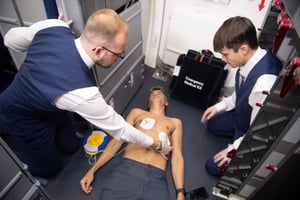
4) Use onboard supplies and equipment MedAire medical kits help MedLink give clear guidance to the crew, such as directing them to the correct pouch for needed medication. The crew also have access to oxygen and often an AED if cardiac arrest is suspected.
5) Coordinate landing and handoff, if needed MedAire provide their clinical evaluation and if the passenger needs urgent evaluation on the ground, crew and flight deck coordinate medical handoff plans so local medical services can meet the aircraft.
What problems happen most often in flight? (MedAire data)
133,886 Total Calls in 2024
59,131 Medical Cases
160+ Cases Per Day
Based on MedAire's in-flight cases, the most common event categories were:
| Category (MedAire in-flight cases) | Share of cases |
|---|---|
| Neurological | 37% |
| Gastrointestinal | 23% |
| Respiratory | 7% |
| Cardiovascular | 6% |
| Injury / External | 5% |
What this means in plain language: More than one-third of all in-flight medical cases are neurological events, primarily fainting, dizziness, and altered mental status. Nearly a quarter involve gastrointestinal issues like nausea, vomiting, and abdominal discomfort. Respiratory complaints (breathing difficulty, asthma-like symptoms) and cardiovascular concerns (chest pain, heart-related symptoms) together account for 13% of cases, while injuries from falls or other trauma make up the remaining 5%.
Cardiac arrest on a plane: why speed matters
Cardiac arrest is one of the most time-critical emergencies in aviation medicine. Cabin crew are trained to:
- Start CPR immediately
- Apply the AED quickly and follow its prompts
For airlines supported by MedAire, MedLink physicians can also help the crew and cockpit coordinate next steps during and after resuscitation efforts, including planning the most appropriate landing and medical handoff.
When would a flight divert for a medical emergency?
Diversions are uncommon relative to total events, but they happen when the passenger's condition is time-critical and cannot be managed safely until the planned destination.
MedAire's role is to help the crew and pilots make decisions using:
- The passenger's symptoms and vital signs
- Response to onboard interventions
- Time to definitive care
- Operational constraints (route, alternates, terrain, fuel, weather)
This is not "medicine versus operations." It is a coordinated safety decision.
Trusted by 67% of the world's top commercial airlines
Next time you fly, remember that you’re supported by a dedicated team of nurses and doctors on the ground - experts who handle hundreds of calls every day to help keep you safe in the air.
Frequently Asked Questions
Have Question? We are here to help
Do airplanes have defibrillators (AEDs)?
Many commercial aircraft carry AEDs, and crew are trained to use them. Availability can vary by airline and jurisdiction.
Can you fly with high blood pressure?
Many people can fly safely with controlled high blood pressure. Talk to your clinician before travel if you have very high readings, recent medication changes, or symptoms such as chest pain, severe headache, shortness of breath, weakness, or confusion. Bring your medications in your carry-on and take them on schedule.
What happens if someone dies on a plane?
If a passenger dies during a commercial flight, whether following a sudden medical event or despite resuscitation efforts, the crew follows established protocols designed to manage the situation with sensitivity, professionalism and respect.
Flight attendants first assess the passenger and begin providing medical assistance, often in consultation with MedLink. Crew members cannot formally declare death, but if certain criteria are present—for example:
- no response and no breathing,
- CPR performed for 30 minutes or more,
- AED used with no return of spontaneous circulation,
…then the person may be presumed deceased. On some occasions a medical volunteer may assist and, in certain cases, help determine that death has occurred.
Crew procedures
Once death is presumed, the crew follows a defined sequence of actions, which typically includes:
- Notifying the captain
The captain evaluates whether the flight should divert or continue, considering both operational factors and humanitarian needs. - Supporting and reassuring nearby passengers
Ensuring calm and providing privacy as much as possible. - Securing the deceased with dignity
The passenger is covered with a blanket, and if seats are available, nearby travellers may be moved. If space allows, the deceased may be repositioned to a quieter area; otherwise, they remain in their seat with the seatbelt fastened. - Using protective equipment
Crew wear PPE when handling the body to maintain hygiene and safety. - Coordinating handover on arrival
Ground staff and airport emergency medical services are briefed ahead of landing to ensure professional transfer and documentation.
Managing the environment onboard
The guiding principles for the crew throughout the event are dignity, minimal disruption, safety and clear communication. They continue to monitor the cabin atmosphere, provide updates to the captain, and maintain connection with ground medical and airport personnel.
How common is inflight death, and who is most affected?
Inflight deaths are rare, and cardiac arrest is the most frequent cause. Based on the MedAire's data, occurrences are:
- More common in male passengers
- Most often among older travellers, with the age distribution skewed toward people in their 70s
This demographic pattern reflects the general medical vulnerability associated with ageing rather than aviation‑specific factors.